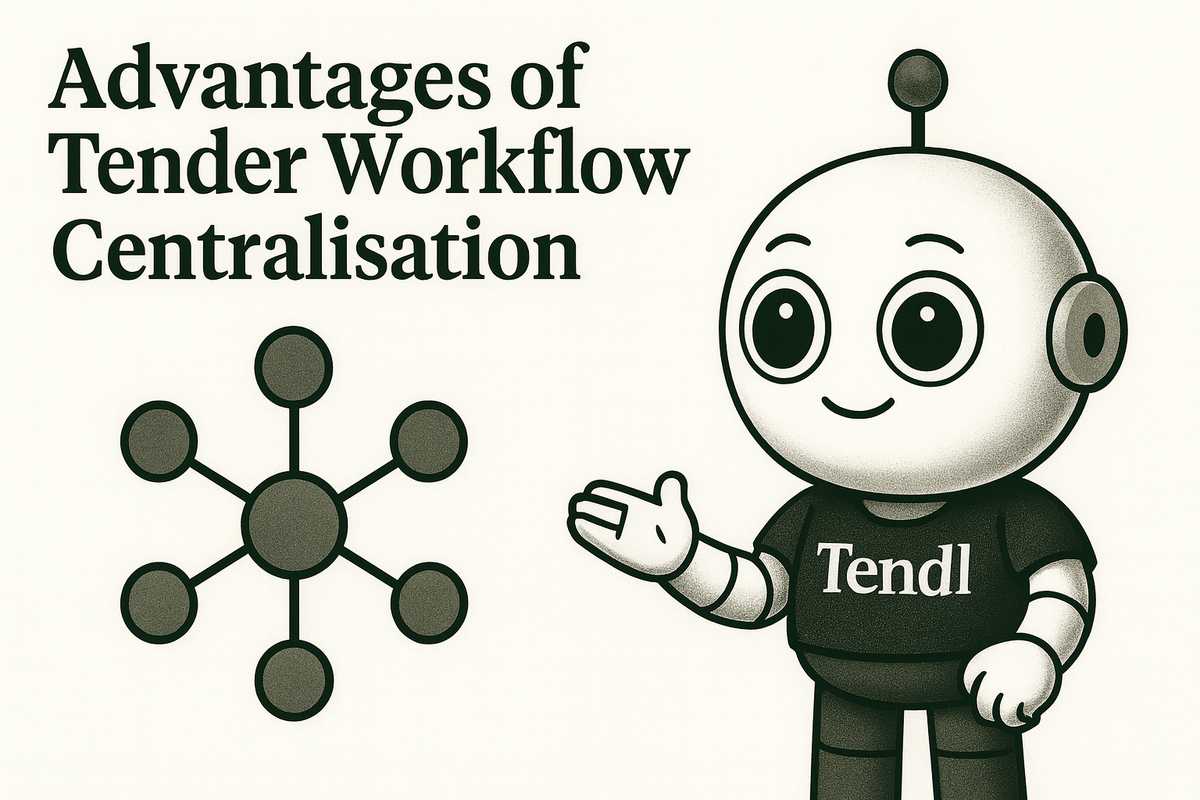
The Advantages of a Centralised Tender Workflow for Better Control, Speed and System Organisation
TLDR: Tendering workflows are often crippled by fragmented systems and disorganised processes, costing organisations significant resources and diminishing decision-making capacity. Centralised systems are the modern advantage to achieve full pipeline control, more predictable performance and clearer team management.
Tendering has long been a complex process featuring fragmented and manual systems. Combine this with relentless back-to-back tender cycles, and the priority for workflow organisation and document streamlining inevitably falls to the bottom of the priority list.
What Are The Costs of a Messy System?
The cost of pushing aside time dedicated to the organisation of documents, past performance and team management is no longer just an administrative concern. Annually tender executives are becoming more and more exhausted, resulting in leadership being forced into constant firefighting rather than focusing on high level decision-making. This is leading to an increase in:
- Team burnout.
- Missed deadlines and lost revenue opportunities.
- Duplicate work or inconsistent quality across submissions.
- Slow go/no-go decisions.
- Poor pipeline visibility.
- Inefficient reviews and unpredictable review cycles.
In short, your system ends up becoming the bottleneck, with fragmented systems becoming the catalyst for lagging performance.
The Introduction of Modern Platforms
Modern platforms now make it possible to fully centralise the tender workflow by bringing together content organisation, team collaboration, approvals, timelines and historical evidence into a single, unified hub. Organisations that embrace this level of alignment are already seeing the benefits, gaining a tender function that is more controlled, predictable and commercially effective.
Below are three core advantages decision makers gain from a centralised tender system.
- A Tender Process That Performs Like a Sales Process
When everything lives in one organised space, the tender process looks and behaves like a sales pipeline, creating:
- Clear qualification stages
- Consistent go/no-go criteria
- Full pipeline visibility
- Tighter control
- Predictable, repeatable workflows
Instead of relying on manual updates and scattered spreadsheets, leaders get real-time visibility of the full tender pipeline, enabling stronger planning and more informed decision-making across the organisation.
- Faster Go/ No-Go Decisions
Many organisations are guilty of taking on too many low-value tenders or taking too long to decide whether to bid.
This costs valuable time that could be invested in higher-value tasks such as competitor analysis, market positioning or building supplier and customer relationships.
Centralisation removes the internal friction that slows down the Go/No Go decision by giving leaders access to:
- Resource availability
- Past performance on similar tenders
- Workload capacity across the team
- Draft timelines and feasibility
When leaders have the data and information contained in one place, decisions can become faster, sharper and more aligned with revenue goals.
- Clarity Over Team Workflow
One of the biggest challenges in the bidding process is managing people. Ensuring smooth and efficient collaboration across departments, especially when proposals involve 300+ requirements, can quickly become a very messy process.
A centralised system that enables team sharing and task assignment gives leaders real-time operational control. This eliminates duplicate work, slow collaboration cycles via email and the risk of losing track of progress across teams. Tools (like Tendl) that allow you to assign proposal tasks to specific owners and manage reviewer sign-off in one place, ensure management has complete visibility over the entire proposal timeline.
With a transparent and clearly defined workflow, the guesswork around progress disappears. Leadership gains back the ability to identify and catch any stagnant processes early before they affect submission quality or jeopardise upcoming deadlines.
Summary
Centralising your tender workflow is more than simple document organisation. It represents a fundamental shift in how your organisation approaches revenue generation by creating an organised, predictable and trackable business process.
Ultimately, centralising your tender workflow delivers three undeniable executive-level advantages:
- Control: clarity over pipeline, performance, and team capacity.
- Speed: faster decisions and shorter turnaround times.
- Scalability: the ability to handle increased tender volume without adding manual effort or administrative overhead.
When all core activity lives in one unified platform, the tendering function evolves beyond a fragmented set of tools and tasks. The result: less time spent coordinating and more time focused on winning.
FAQ: Centralising Your Tender Workflow (For Tender Leadership)
1. Why should executives prioritise centralising the tender workflow?
Centralising the tender workflow gives leaders real-time visibility, stronger operational control, and faster decision-making. It removes inefficiencies that limit revenue growth and ensures resources are allocated to the highest-value opportunities.
2. How does centralisation improve tender win rates?
Win rates improve because teams gain the time and clarity needed to focus on quality. Instead of managing scattered documents and manual processes, they can dedicate more effort to strategy, value articulation, and customer relationships.
3. What business risks does a fragmented tender process create?
Disjointed workflows lead to missed deadlines, inconsistent submissions, duplicated work, slow go/no-go decisions, and poor oversight. This increases operational risk, reduces competitiveness, and can cause unnecessary revenue leakage.
4. How does centralisation support better executive decision-making?
A centralised system provides leaders with accurate data on resource availability, team workload, past performance, and pipeline health. This enables faster, evidence-based decisions and helps you avoid low-value tenders that drain resources.